Posts

Groovin’ Goliath (and the slingshot of doom)

Image
Groovin’ Goliath (and the slingshot of doom) for saxophone choir combines elements of blues, traditional and non-traditional tonal structures, shifting metrical landscapes, and saxophonic sound effects in this retelling of the epic tale of David and Goliath. The giant still loses the fight, but the biggest saxes reign supreme in this battle royale! Scoring: SSAAATTB(Bs) - 2 Soprano, 3 Alto, 2 Tenor, 1 Baritone, Optional Bass which doubles Baritone. World Premiere: 2018 World Saxophone Congress by the Arkansas Saxophones under the direction of Dr. Jackie Lamar (University of Central Arkansas, retired) On YouTube at  https://www.youtube.com/watch?v=9Beq3Hy2sh0&t=1s Advanced Techniques: Slap-Tongue (all parts), Multiphonics (Baritone)

Nevermore

Image
As this is an unaccompanied piece, ANY saxophone is acceptable. While most soloists will undoubtedly opt to use alto or soprano, the composer welcomes renditions of this piece on any of the larger saxes as well. This piece was inspired by Nevermore: An Evening With Edgar Allen Poe, a single act play featuring Jeffrey Combs. My good friend, Dr. Brent Bristow of Arkansas State University, Beebe, convinced me to go see the play when it was presented there in March of 2018. That performance by the legendary Mr. Combs inspired this piece. Why unaccompanied saxophone? Brent Bristow and I have been close friends since high school, and since he is the one who convinced me to see this show, and given that he plays classical saxophone (yes, that IS a thing!), I figured saxophone would kill two birds with one reed… or something like that. The show itself is a one-man performance, so that’s why this piece is unaccompanied. I toyed with the notion of including some text from the show. Eventua...

Temporal Physics

Image
Temporal Physics is a single-movement sonatina for alto saxophone and piano. Featuring a cornucopia  of meter changes, the piece explores various stylistic treatments of two brief melodic motifs. Temporal  Physics drops hints of different musical eras while remaining a truly contemporary display of soloistic  virtuosity.

One Zero Zero

Image
One Zero Zero  was written in 2016 to commemorate the 100th anniversary of the Lawrence County School District (formerly Walnut Ridge Schools) in Walnut Ridge, Arkansas. The piece is dedicated to the Walnut Ridge High School "Pride" Band and long-time director John Long. One Zero Zero  opens with a fanfare based partly upon the Morse code for the numbers 1, 0, and 0, leading up to an energetic, cinematic style main theme.  This opening fanfare provides an excellent opportunity to introduce your students to 5/8 time in an accessible and exciting setting (one measure of 5/8, two measures of 3/4 being the pattern).  Use of combinations of 3/4 and 4/4 which appear frequently in the main theme could also be used as a step-stone for teaching longer asymmetrical meters such as 7/4 (though 7/4 does not appear in the piece). The middle section of the piece references a hymn based on Psalm 100 found in the Genevan Psalter of 1551, later harmonized in 1564 by the French com...

The Privateers

Image
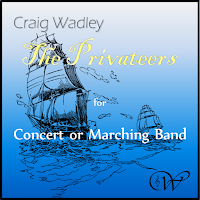
The Privateers  is a swashbuckling depiction of an oceangoing pirate adventure, presented in the form of a march.  The piece starts with a brief fanfare, followed immediately by a rousing melody in the style of an old sea-shanty.  Images of sailing upon an endless sea of stars come to mind as a tranquil nocturne is presented, but the peace is shattered as cutlasses and sabers clash in a dogfight sure to end in Davy Jones’ locker!  The music swells to a dramatic conclusion as our mighty galleon surges across a stormy sea. Instrumentation The Privateers  comes with full sets of both concert/stage and marching/field parts, allowing for great flexibility in your performance venues. Contemporary marching bands and drum & bugle corps utilize specialized field percussion which is typically not used in a concert setting.  With this piece, the use of "outdoor" percussion (quad toms and a tonal bass drum line) onstage is encouraged, although not required....

Trust.

Image
A beautiful lyric essay for piccolo (or flute) and piano utilizing nontraditional harmonies and modalities. While the technical requirements of the piece are of only intermediate difficulty, the demand for musical expression is high for both the soloist and accompanist.  Trust  is written as a musical meditation on Psalm 143, verses 1-11.  These verses from the Bible underscore one of the basic (yet sometimes uncomfortable) truths of human existence:  we need help.  People often find it difficult to trust in anyone or anything other than  themselves, but no matter how much we may desire complete independence and  autonomy, human beings are simply not equipped to weather the storms life  brings on our own.  The difficulties of  life can in fact make us feel isolated and deserted. Our culture’s celebration  of strength and independence silently imply that we are "weak" if we are unable  to stand alone, yet it is during troubling...

Revelation

Image
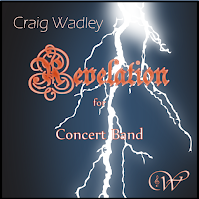
Revelation  was commissioned in 2002 by Dru Davison, then Director of the Brookland High School Band in Brookland, Arkansas.  Soli section for Flute, Clarinet, Alto Sax, and Tuba soloists, with percussion. In 2002, the United States was still reeling from the deadly and devastating terrorist attacks of September 11, 2001. In the wake of the tragic loss of life and the shaking of the nation’s sense of security, many people feared what the future might bring.   Revelation  begins with a question: "Where do we go from here?" The piece presents the uncertainty and sense of foreboding felt by so many Americans at that point in history, followed shortly by the only possible response: "We must move forward." The music moves toward its climax with new energy, driving onward with a sense of urgency, reflecting the heart and will of a nation determined to rise above tragedy. LISTEN on YouTube PURCHASE on SheetMusicPlus (parts) PURCHASE on SheetMusicPlus (conductor's ...